
The Odyssey: The Hero’s Journey and the Meaning of Home
Aug 18, 2026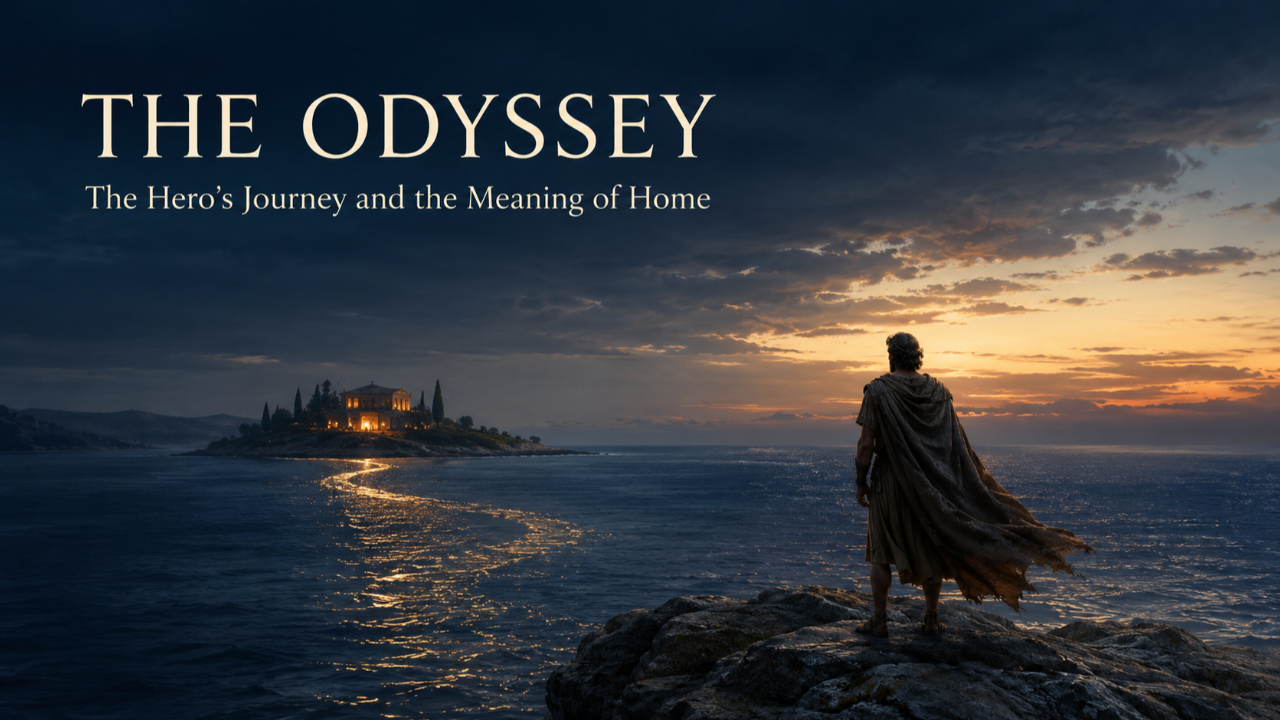
The Odyssey: The Hero’s Journey Is Not About Adventure. It’s About Finding Your Way Home.
Spoiler warning: This reflection discusses key moments and themes from Christopher Nolan’s The Odyssey.
We often talk about the Hero’s Journey as if it were an adventure.
A call. A departure. Trials. Monsters. Mentors. Enemies. Transformation. Return.
But watching Christopher Nolan’s The Odyssey, I was reminded of something far more human:
The Hero’s Journey is not really about how far we travel. It is about whether, after everything we have experienced, we can still find our way home.
And perhaps even more importantly:
Who are we when we finally get there?
For me, as someone who teaches the Hero’s Journey in our story-coaching work at Digital Dolphins, this film is almost a masterclass.
I have spent much of my professional life inside stories — as a creative producer of more than 550 hours of television fiction, as a lecturer in film and television, and now as a storytelling and AI media coach. Yet The Odyssey reminded me why these ancient structures continue to matter.
Because beneath all the monsters, battles and extraordinary images, Christopher Nolan has made a film about something profoundly ordinary.
The longing to come home.
Three critics. Three very different Odysseys.
What fascinated me after seeing the film was how differently critics interpreted Nolan’s choices.
Peter Bradshaw in The Guardian saw the movie as much more than a mythological adventure. For him, Nolan turns Odysseus’ journey into a story about the psychological aftermath of war — about soldiers who may physically return from battle but take years, perhaps decades, to return emotionally or spiritually. He praised the film’s ambition and saw Matt Damon’s Odysseus as a man carrying the sadness and consequences of everything he has experienced.
I find that interpretation incredibly powerful because it changes the meaning of “return.”
You can reach your destination without actually arriving.
Amy Nicholson in the Los Angeles Times admired the enormous craft of the film but saw something different. She argues that Nolan has reshaped Homer’s hero to fit his own recurring fascination with guilt, memory, destructive genius and morally troubled men. Her criticism is that in doing so, Nolan softens some of the original Odysseus — particularly his cunning, ego, contradictions and appetites. The Homeric hero becomes a more recognisably Nolan-like wounded protagonist.
And then there is the much more sceptical Jacques Mandelbaum in Le Monde. He praises some of the extraordinary visual episodes but argues that Nolan’s immense cinematic vision comes at a cost: the characters can disappear beneath the spectacle. For him, Damon’s Odysseus is far removed from Homer’s famously wily hero, and several supporting characters lack the depth they deserve.
Three critics.
One sees psychological transformation.
One sees impressive filmmaking combined with an overly “Nolanised” hero.
One sees spectacle overwhelming humanity.
And this is exactly why storytelling is so fascinating.
We never simply watch the same story. We meet it with our own story.
What I saw was the word “home”
For me, the most powerful parts of The Odyssey were not necessarily the enormous images or legendary encounters.
They were the human moments.
And one word kept returning:
Home.
When his son wonders, “Will he ever come home?”
When Odysseus speaks with Penelope and says, “I’m not home yet.”
And finally, the question that stayed with me at the end:
“Where to go from home?”
Those moments touched me deeply.
Because suddenly The Odyssey was no longer a story written thousands of years ago.
It was our story.
What is home?
Is home a geographical place?
A person?
A relationship?
A sense of belonging?
Is home the person we were before our journey began?
And what happens when that person no longer exists?
Perhaps this is one of the great truths of the Hero’s Journey: the hero cannot simply return to the life they left behind because the journey has changed them.
The external journey may end.
The internal one does not.
And this is where the Double Hero’s Journey begins
In our Digital Dolphins story-coaching work, we go one step further.
I call it the Double Hero’s Journey.
Before we can guide an audience, customer, student, community or supporter through transformation, we need to understand transformation ourselves.
First, we travel the journey.
We encounter uncertainty. We question what we know. We struggle with obstacles. We discover allies. We face fears. We change.
Then comes the second journey:
How do we use what we have learned to help somebody else make their own crossing?
This is particularly important for changemakers.
Whether you are a founder trying to bring people behind a mission, a teacher helping students understand a difficult idea, a coach creating trust, or an advocate trying to shift a deeply embedded social narrative, your audience is not simply waiting for information.
They are standing at the beginning of a journey.
Your job is not to tell them how heroic you are.
Your job is to create the story that helps them move.
That is why The Odyssey is such a valuable film for anyone interested in storytelling.
Odysseus faces external monsters, certainly.
But the bigger question is what the journey does to Odysseus himself.
Maybe the destination isn't the point
This is where I disagree, at least partly, with critics who feel Nolan has moved too far from Homer’s original Odysseus.
Perhaps he has.
But adaptation is also interpretation.
And for our time, I find the question Nolan appears to ask deeply relevant:
What happens when the hero who returns is no longer the hero who departed?
That question matters far beyond cinema.
Every changemaker eventually encounters it.
We begin with an idea of what success will look like.
Build the organisation.
Launch the campaign.
Raise the funding.
Change the policy.
Create the course.
Grow the community.
Tell the story.
Reach “home.”
But transformation has an inconvenient habit of moving the destination.
We arrive — and discover another question waiting for us.
Now who am I?
And perhaps:
Where do I go from home?
That is why Christopher Nolan’s The Odyssey moved me.
Yes, Nolan is a brilliant filmmaker. Yes, Matt Damon gives Odysseus an extraordinary humanity. Yes, the scale and craft are spectacular.
But I left the cinema thinking about something much smaller.
A son waiting for his father.
A woman waiting for her husband.
A man trying to understand whether he has truly returned.
And one simple word carrying the emotional weight of an entire epic:
Home.
Now I would love to hear your Odyssey.
What did you experience when you watched the film?
Did you see a story about home? War? Masculinity? Guilt? Family? Leadership? Transformation? Or something completely different?
Tell me in the comments: what was the moment in The Odyssey that stayed with you — and why?
Because the most interesting thing about a powerful story is not that we all understand it in the same way.
It is that it opens a door to our own.
And if you want to explore how the Hero’s Journey, AI and purposeful storytelling can help you turn your own ideas into stories that connect, move people and create change, join us inside the Digital Dolphins Membership — a community where changemakers meet, learn, experiment and support one another as we make our own waves.
🐬 This is where impact meets craft. This is Digital Dolphins.
PS. The three critical perspectives are grounded in reviews published by The Guardian, the Los Angeles Times and Le Monde in July 2026.
✨ Together, we shape stories that move the world
Come and tell your story with us — inside a vibrant, creative community of purpose-led changemakers.
🐬 Find out more about our Circle of Creative ChangemakersBy subscribing you agree to our Privacy Policy.